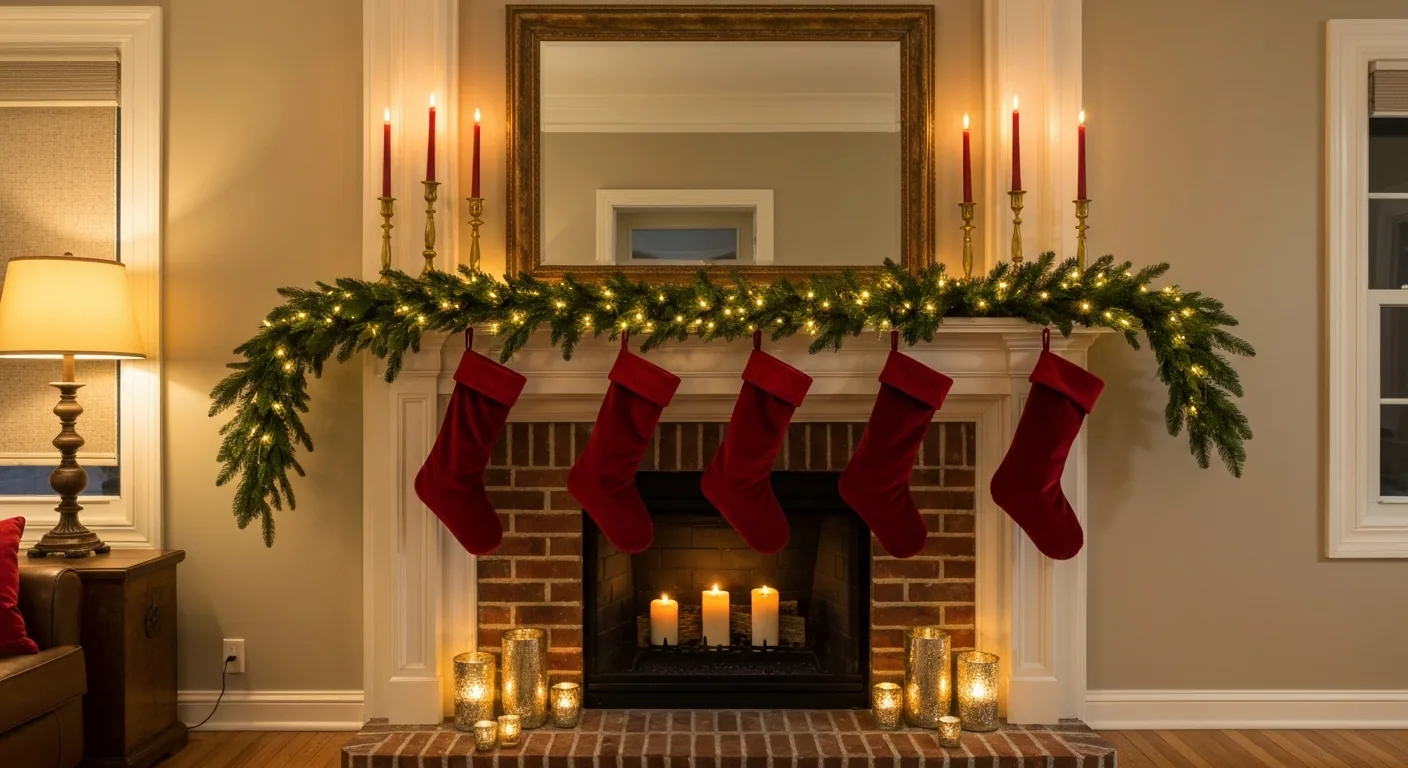
The fireplace mantel is the second-largest visual moment in a living room after the Christmas tree. A well-styled mantel ties the entire room together. A poorly styled one, or an unstyled one, leaves the room feeling incomplete regardless of how good the tree looks. The techniques in this guide apply to traditional brick fireplaces, painted wood mantels, marble surrounds, and electric fireplace consoles. All 85 ideas are organized by element so you can work through them in sequence.
Foundation: garland and mounting
The garland is the structural element that every other mantel decoration hangs from or clusters around. Get the garland right before touching anything else.
1. Measure the mantel and choose the correct garland length
The garland should be 1.5 times the mantel length. A 60-inch mantel needs a 9-foot garland. A 72-inch mantel needs a 12-foot garland. An 84-inch mantel needs a 12 to 15-foot garland. The extra length creates the drape and the extensions past each end. A garland that is exactly the same length as the mantel will look undersized and flat.
2. Secure with adhesive hooks before hanging, not after
Mount small adhesive command hooks (rated for at least 3 pounds each) underneath the front edge of the mantel shelf at 12 to 18-inch intervals before unboxing the garland. Once mounted and cured for 30 minutes, they will hold a fresh or faux garland without any visible hardware from the front. This is the single technique that separates a professional-looking mantel from a garland that slumps.
3. Wire in fairy lights before hanging the garland
Thread a strand of 100 battery-operated warm white fairy lights through the garland before mounting it. Wrap the lights loosely around the garland stem, spacing them evenly. This approach embeds the light source inside the garland rather than laying it on top, which looks more natural and avoids the visible wire problem that plagues post-hanging attempts.
4. Drape six to eight inches past each end of the mantel
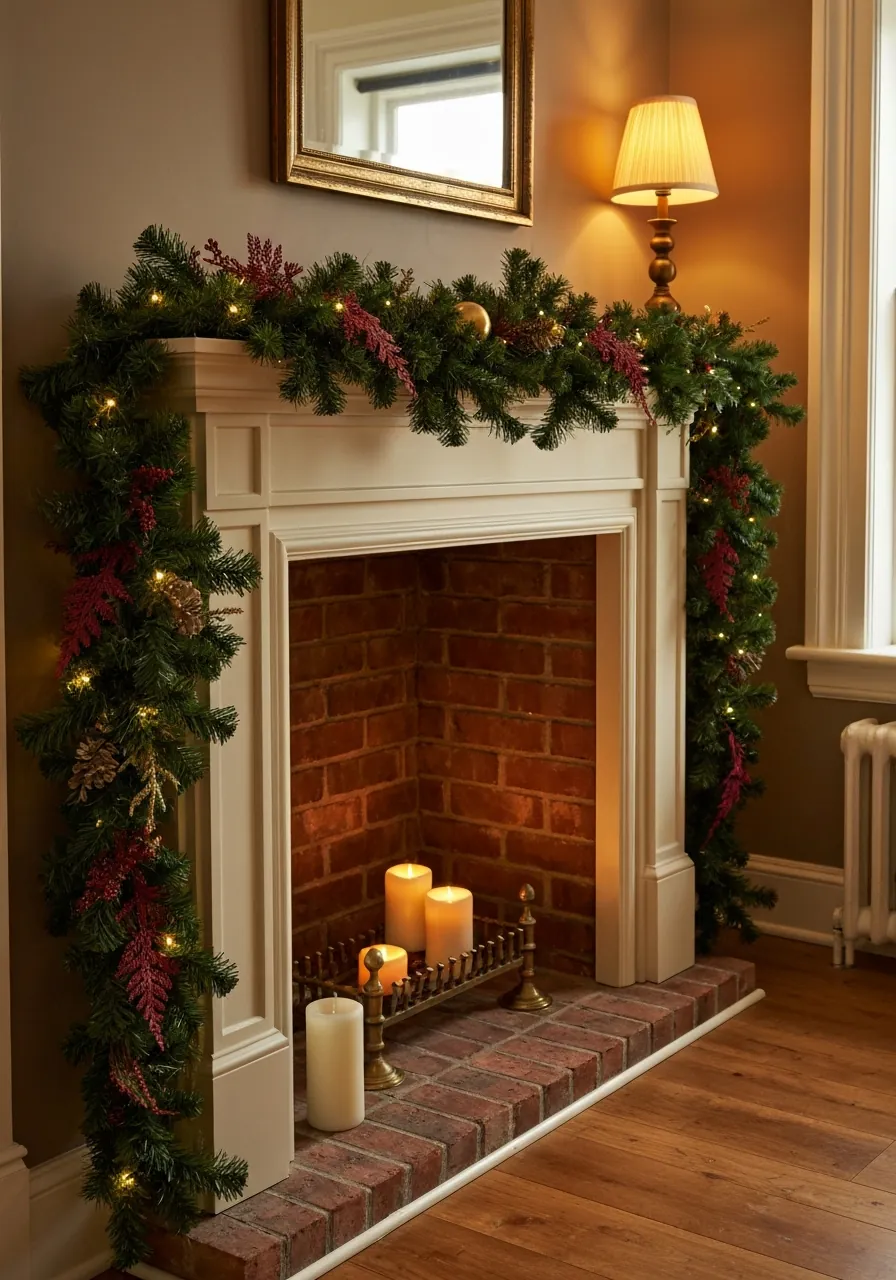
After mounting, let six to eight inches of garland extend past each end of the mantel shelf. This makes the garland appear to flow off the edges organically rather than stopping abruptly at the mantel boundary. A common mistake is ending the garland exactly at the mantel end, which makes the mantel look smaller and the garland look like a measuring tape.
5. Create a center drape of three to four inches
Allow the center section of the garland to drape three to four inches below the front face of the mantel shelf. This creates the classic shallow-arc garland profile visible in magazine spreads. Do not pull the garland taut across the full length; the drape is what gives it depth.
6. Choose garland density for your fireplace size
A pencil-thin 2-inch diameter garland on a deep 8-inch mantel shelf disappears visually. For a traditional 72-inch wide mantel with a 6-inch shelf depth, use a 5 to 6-inch diameter pre-lit garland. For a smaller, shallower mantel console (common with electric fireplaces), a 3 to 4-inch garland reads well without overwhelming the surface.
7. Add a second garland layer for extra fullness
On large, deep mantels, a single garland strand can look thin. Lay a second complementary garland on top of the first, offset slightly so the branch tips of the second garland fill in the gaps of the first. Pair a classic pine garland with a eucalyptus garland for a green-and-gray tonal layering. Or pair a pre-lit pine garland with a berry-and-pine garland on top for extra texture and color.
Focal piece: the center back of the mantel
The focal piece at the center back of the mantel is the anchor of the entire display. Everything else supports it.
8. Use a large mirror for maximum light reflection
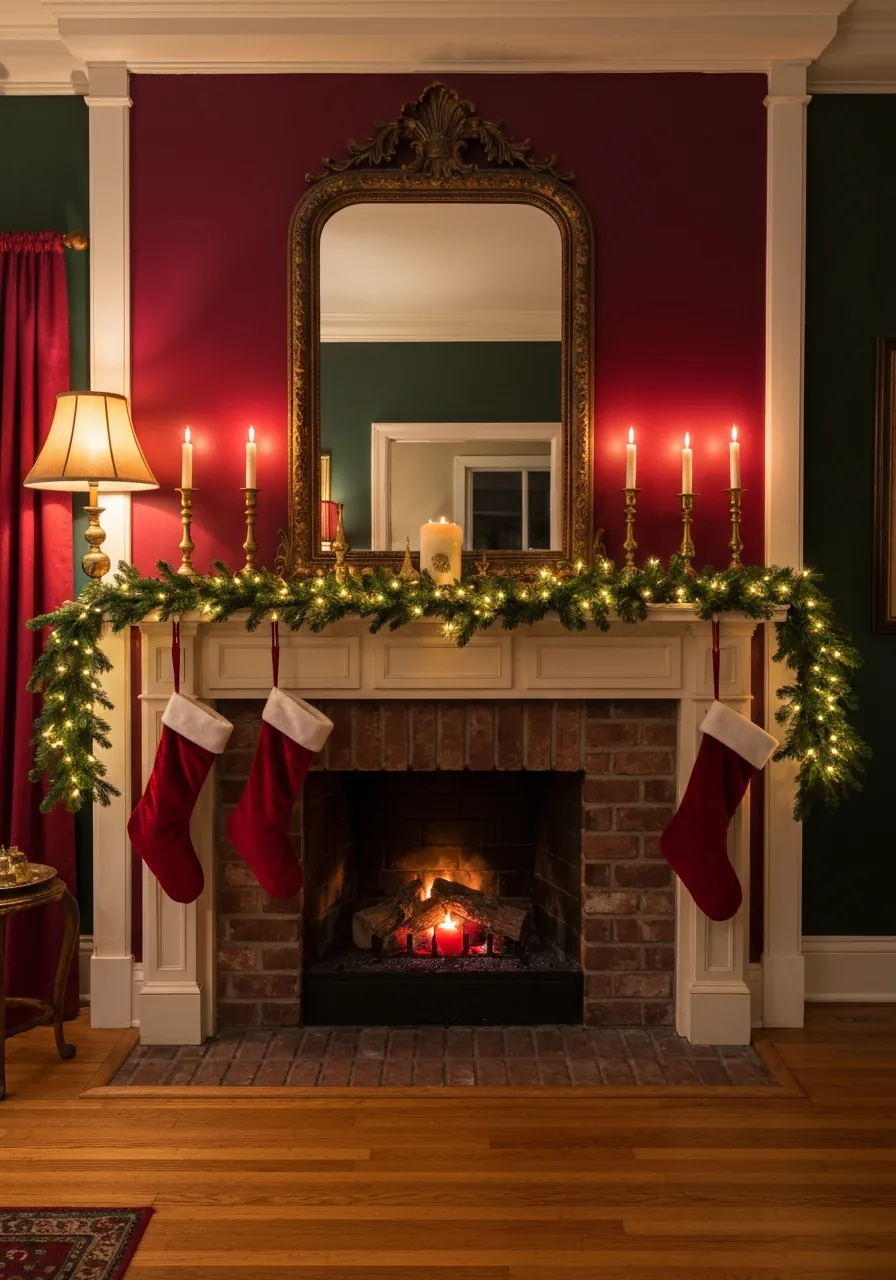
A mirror at the center back of the mantel doubles the visual depth of the display by reflecting the garland, candles, and tree lights. Lean it against the wall rather than mounting it permanently for seasonal flexibility. For a 60-inch mantel, a mirror 30 to 36 inches wide reads well. For a 72-inch mantel, go 36 to 48 inches wide.
9. Hang a large wreath as the focal piece
A 24 to 30-inch wreath centered on the wall above the mantel serves as the visual anchor without requiring any surface space. Mount a small nail or hook centered on the wall above the mantel before the holiday season. A wreath with a large velvet bow at the top adds color without needing any additional centerpiece objects. Leave at least 4 inches between the wreath bottom and the garland top so they read as two distinct elements.
10. Lean a piece of seasonal art or a chalkboard sign
A framed botanical Christmas print, a vintage holiday poster, or a chalkboard sign with a hand-lettered phrase in chalk marker leans against the wall at the center back without any wall mounting. This approach works particularly well for renters. Change the art each year without leaving any marks. For balance, the art piece should be at least 24 inches wide for a 60-inch mantel.
11. Use a large lantern as the focal anchor on smaller mantels
On a narrow console mantel with limited surface depth, a tall lantern (16 to 20 inches) with a battery-operated pillar candle inside serves as both the focal piece and a light source. Surround it with small ornaments, a few pine sprigs, and a brass reindeer figurine for a complete vignette without crowding a small surface.
12. Style a large wooden letter or monogram
A large wooden letter (12 to 16 inches tall) in the first letter of the family surname, spray-painted in matte white or gold, placed at the center back of the mantel adds a personal and seasonal touch. Lean a small wreath against it and add a few pine sprigs at its base.
Stocking placement
Stockings are the most personal element on the mantel and the one most commonly hung incorrectly.
13. Measure equal spacing before driving any hook
For four stockings on a 60-inch mantel, space hooks at 10, 20, 30, and 40 inches from the left edge. For three stockings, space at 12, 30, and 48 inches. Measure twice before using any adhesive or driving any hook. Uneven stocking spacing is immediately noticeable and difficult to fix without leaving marks.
14. Choose stocking holders that match your metal finish
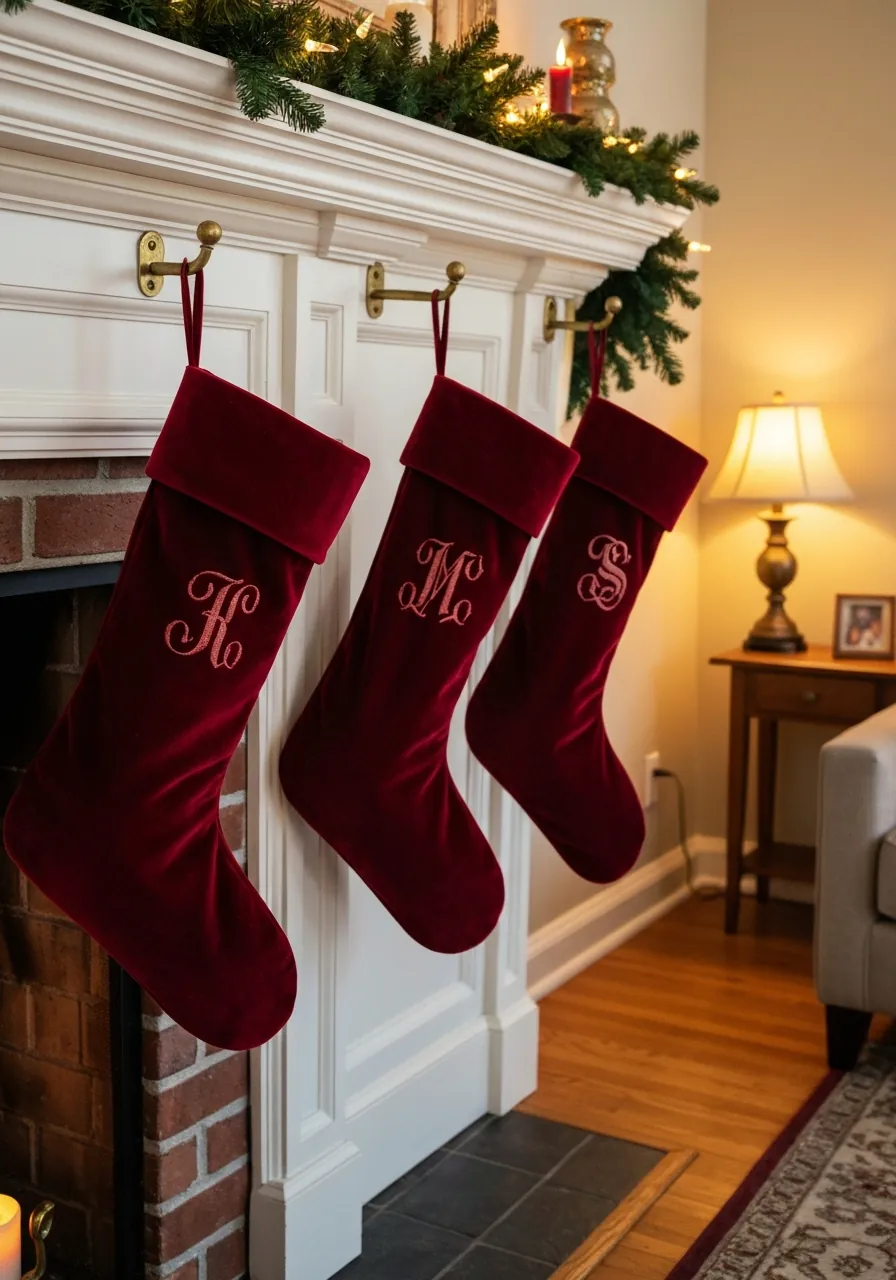
Stocking holders should match the dominant metal finish in the room: brushed gold, matte black, antique brass, or polished nickel. Mismatched stocking holders distract from the rest of the display. A full set of four matching holders costs under $30 at most home goods retailers and lasts indefinitely.
15. Stuff stockings with tissue paper to hold their shape
A flat, empty stocking looks deflated and unfinished. Pack the top third of each stocking with white or cream tissue paper so it holds its shape and stands upright. The gift-fill below the tissue paper line is invisible from the front. Stuffed stockings photograph significantly better than flat ones.
16. Choose stocking sizes proportionate to the mantel scale
For a large traditional mantel 72 inches wide or more, 18 to 21-inch stockings look proportionate. For a smaller console mantel or apartment-style fireplace surround, 14 to 16-inch stockings read correctly. An 18-inch stocking on a small mantel dominates the display; a 12-inch stocking on a grand mantel disappears.
17. Add a name tag or monogram charm to each stocking
Small brass letter charms, clip-on letter tags in acrylic, or hand-stamped leather name tags attached to the stocking cuff add personalization and help avoid stocking-mix confusion on Christmas morning. Use a small safety pin to attach a card stock tag behind the cuff fold if no other tag attachment is present.
Candles and light sources
Candle placement transforms the mantel from a daytime display into an evening focal point.
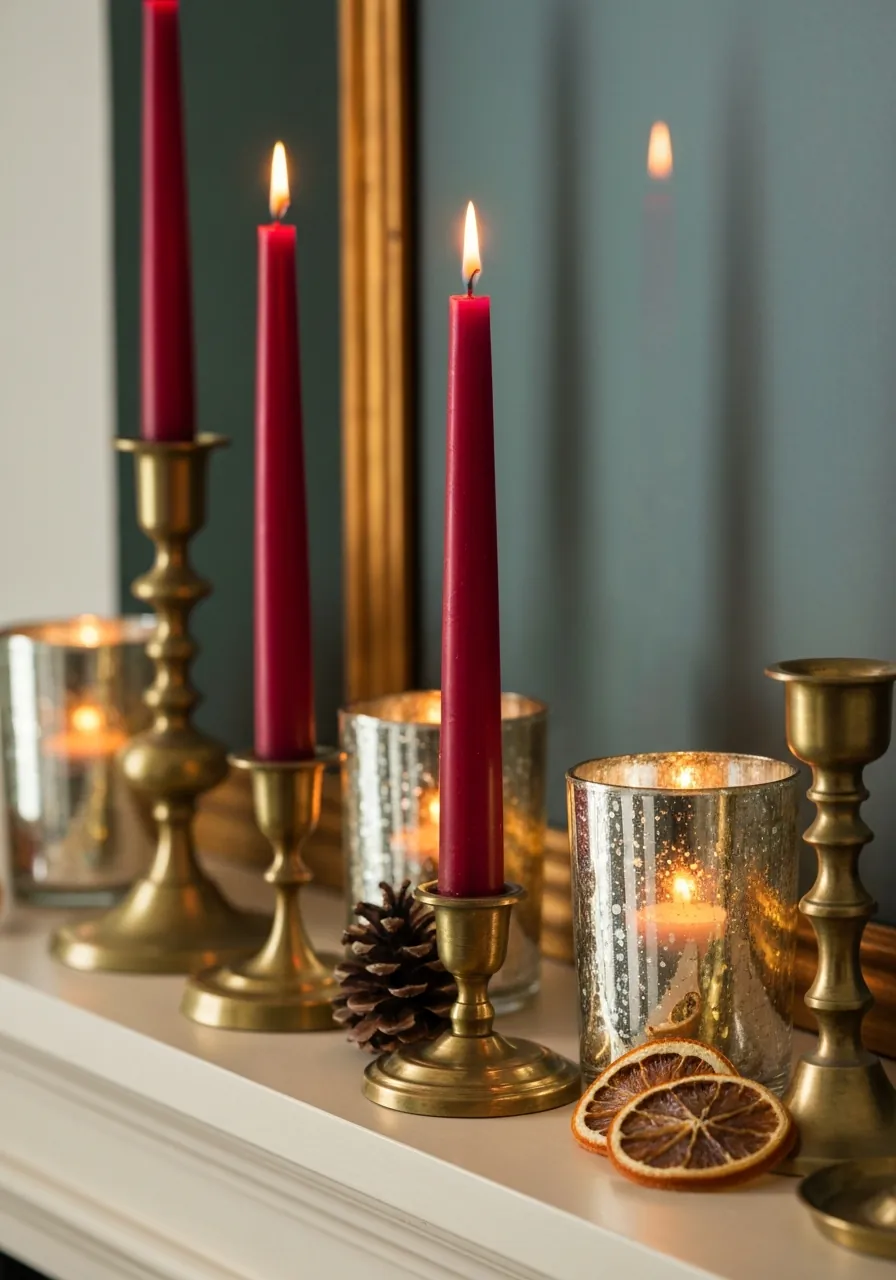
18. Use candlesticks of varying heights on each end
On each end of the mantel, place one tall and one shorter candlestick rather than a matched pair of the same height. A 12-inch candlestick paired with a 7-inch candlestick on each side creates visual rhythm. The height variation draws the eye from end to center and back. Both sides should be roughly the same total visual weight, though not identical.
19. Choose taper candles in colors pulled from the garland or stockings
Deep red tapers mirror the stocking color. Cream or ivory tapers work universally. Forest green tapers echo the garland. Avoid white tapers with a pure-white mantel, as the candles disappear. Pick a color one shade deeper than the lightest element in the display for the candles to read as a deliberate choice.
20. Switch to battery-operated tapers for a working fireplace
For a working fireplace, place battery-operated taper candles rather than real ones on the mantel. High-quality battery tapers with a real-wax surface and a flame-flicker LED look indistinguishable from the real thing in photographs and through the room. They run safely while the fire is active below. Set them to a timer so they turn on automatically at dusk.
21. Use pillar candles in a tray for the center section
A rectangular wooden tray or a mirrored tray placed in the center of the mantel (in front of or beside the focal piece) holds three pillar candles in varying heights, surrounded by small ornaments, pinecone clusters, or cranberries. The tray unifies the cluster and makes it easy to lift off for fireplace use.
22. Add mercury glass votives for low-level warm glow
Three or four mercury glass votives placed between the larger candlesticks or tucked into the garland add small pools of warm light at eye level when viewed from seated position. Mercury glass amplifies the light and adds the antique silver tone that reads as luxurious in Christmas mantel displays.
23. Use clip-on ornament candle holders in the garland
Small clip-on candle holders designed for Christmas tree branches also work in garlands. Clip them to garland branch tips and place a battery-operated tea light in each. This adds light points directly in the garland for an effect similar to a Victorian-era candle-lit Christmas display without any fire risk.
Vignette objects: building the scene between the anchor pieces
The objects placed between the focal piece and the candlesticks build the story of the display.
24. Work in odd numbers: three or five objects per zone
Visual design rule: odd numbers create tension and interest, even numbers create symmetry and stasis. A zone of three objects (tall, medium, low) draws the eye more effectively than two or four. Divide the mantel into three zones: left, center, right, and treat each as a three-object vignette.
25. Vary object height, material, and texture within each zone
A tall brass candlestick, a medium mercury glass votive, and a short pine cone at the base: three different heights, three different materials (metal, glass, natural), three different textures (smooth, reflective, rough). This variation is what gives a mantel display visual depth when photographed.
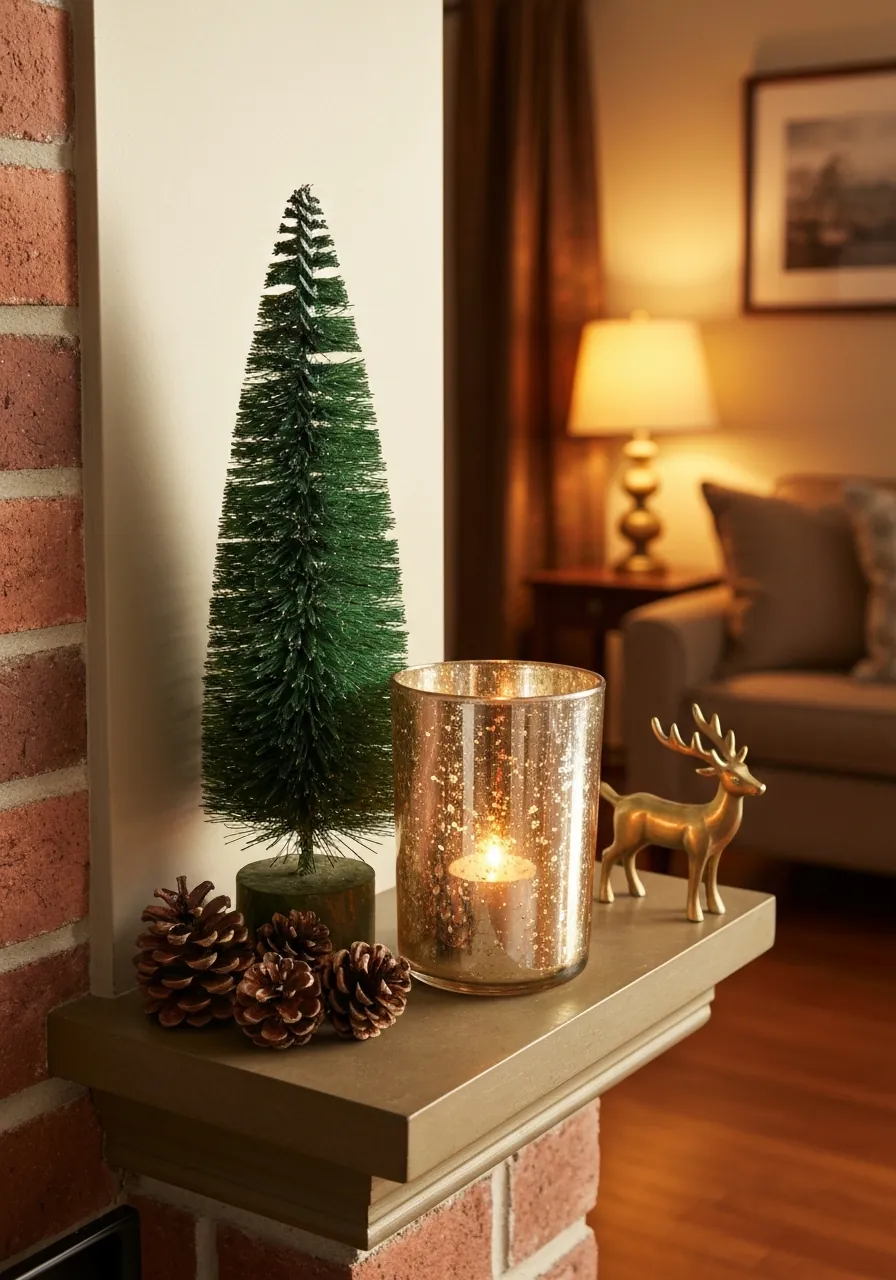
26. Add small bottle-brush trees to the outer ends
A 6 to 8-inch bottle-brush tree in forest green, snow-white, or flocked white placed at each outer end of the mantel grounds the display with a vertical element that echoes the main Christmas tree. Snow-dusted bottle-brush trees add a winter texture to the display without requiring any additional greenery.
27. Clip small ornaments directly to the garland
Wire ornament hangers allow small ball ornaments to be clipped directly to garland branch tips. Using 3 to 5 ornaments in the same color as the main tree ornaments connects the mantel display to the tree display across the room. Deep red ornaments clipped to a green pine garland are the highest-contrast option; clear glass ornaments clipped to a mixed eucalyptus-pine garland are the most subtle.
28. Tuck small sprigs of fresh or faux berry stems into the garland
Red berry stems (real or faux) tucked into the garland at 8-inch intervals add color points and a natural fullness that pre-made garlands often lack. Push each stem 2 to 3 inches into the garland branches so it holds without wire or adhesive. For a farmhouse look, use cotton stems and dried orange slices instead of berries.
29. Use a small village scene in the garland foreground
On wide, deep mantels, a 2 to 3-piece miniature village scene (a lit church, a general store, and a bare tree) placed in front of the garland creates a low-height scene that does not compete with the focal piece height. Wire them in place with floral wire if the mantel vibrates from foot traffic.
30. Add a brass or wooden nutcracker at one end for scale
A 12 to 15-inch nutcracker placed at one end of the mantel adds a classic Christmas character element and provides a strong vertical contrast against the horizontal garland line. Pair it with a small lantern at the other end for asymmetrical balance.
Color palettes for the mantel
31. Classic red and forest green
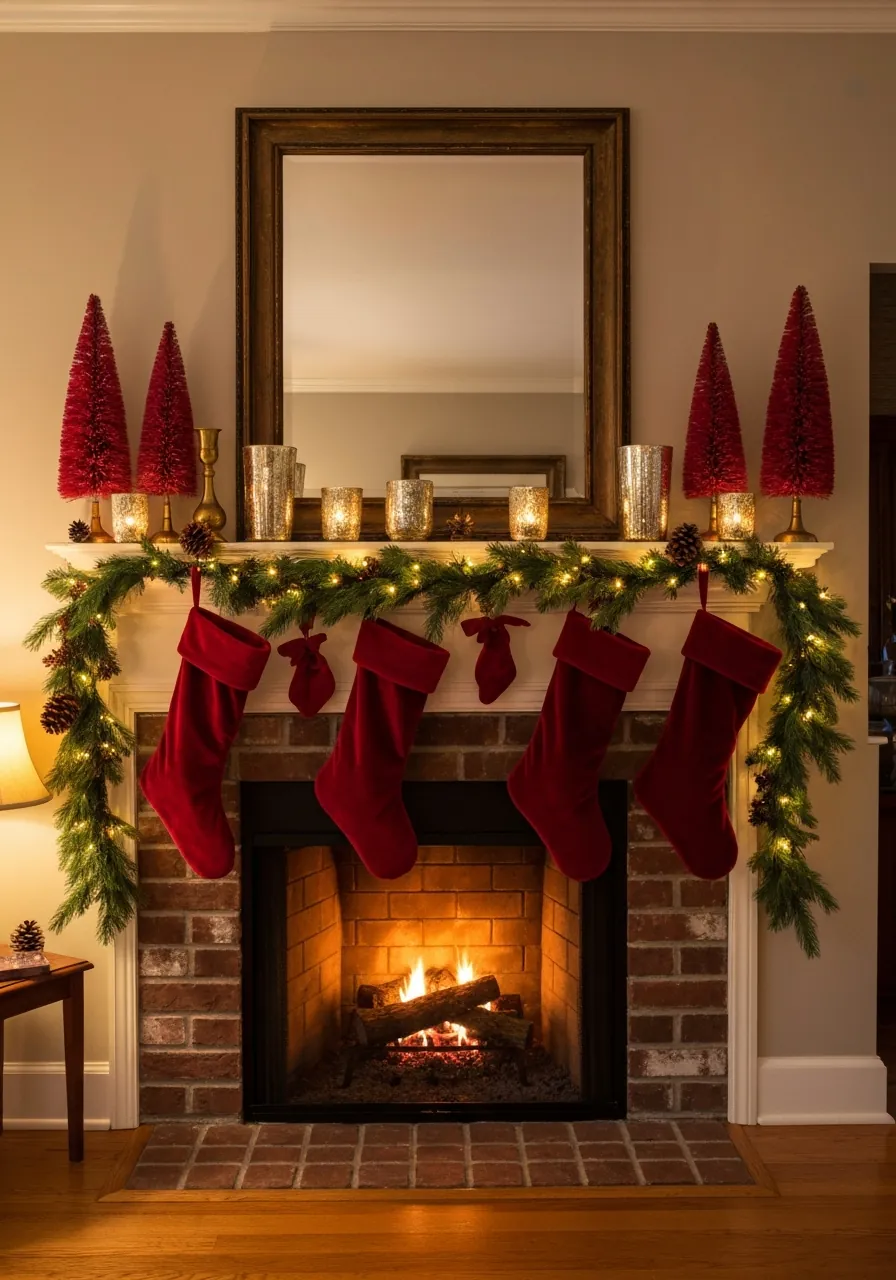
Deep red velvet stockings, forest green pre-lit garland, warm brass candlesticks and stocking holders, and red and gold ornament clips on the garland. This is the highest-contrast mantel palette and the one that reads most strongly as Christmas from across the room.
32. White and gold winter
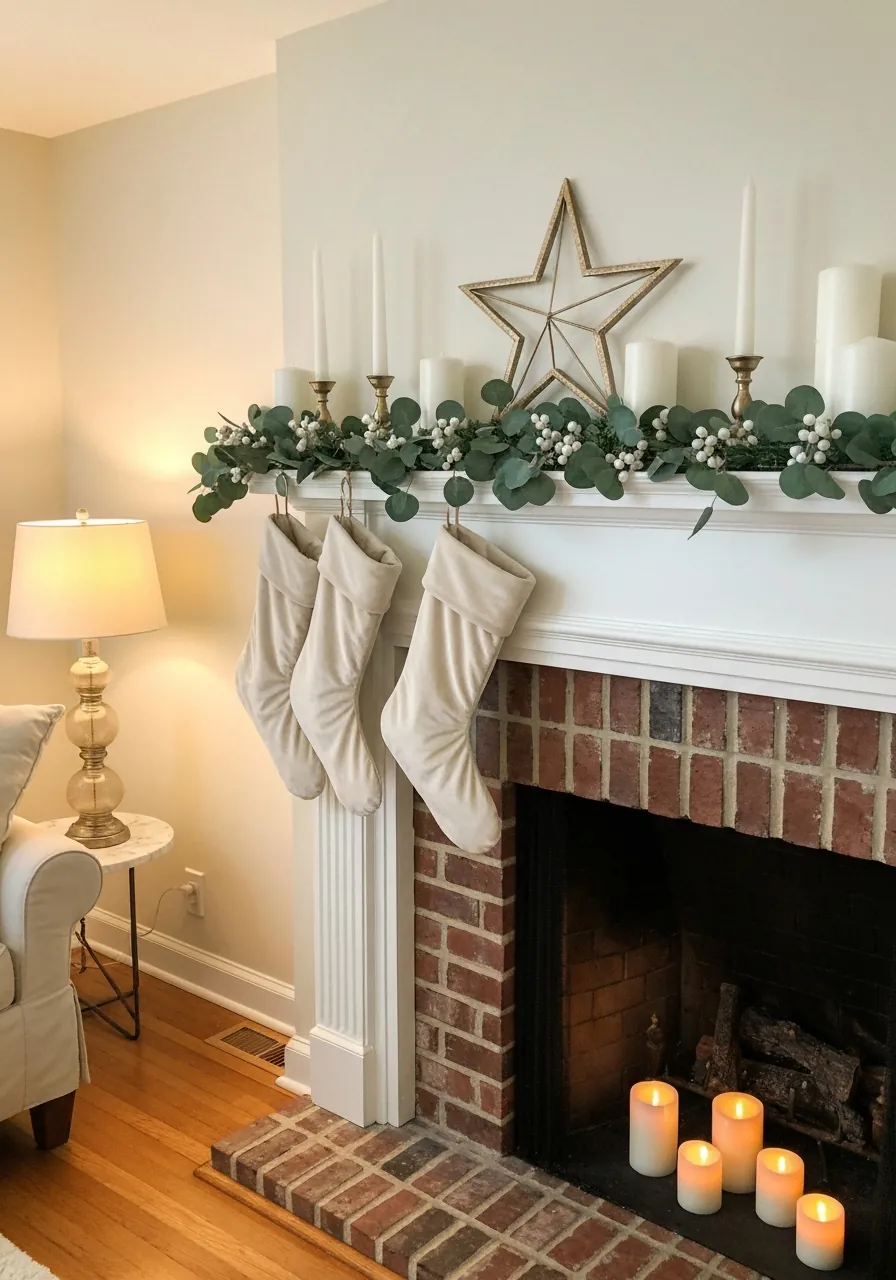
Ivory and cream velvet stockings, a white-flocked or eucalyptus garland, champagne gold stocking holders and candlesticks, and gold and clear glass ornament clips. This palette works in rooms with white or light gray walls and reads elegant without the red-green contrast.
33. Farmhouse neutral
Buffalo plaid stockings in red and black, natural cedar or pine garland, galvanized metal or matte black stocking holders, simple pillar candles in cream, and dried orange slices and cotton stems tucked into the garland. This palette keeps the natural and organic feeling consistent with the overall farmhouse aesthetic.
34. Blue and silver for a non-traditional look
Navy or royal blue velvet stockings, a pine garland with silver berry picks, polished nickel or brushed silver stocking holders, silver candlesticks, and icy blue and silver ornament clips. This palette works in rooms with cool-toned walls and reads distinctly different from the traditional Christmas palette.
35. Blush and sage for a soft romantic look
Blush velvet stockings, a sage and eucalyptus garland, brushed gold stocking holders, rose gold or blush candles, and dusty pink ornament clips with dried lavender stems tucked into the garland. This palette is ideal for living rooms with warm-toned neutral walls and works particularly well in bedrooms.